
Insider risk is the chance that someone with legitimate access to your systems — an employee, a contractor, or a business partner — causes harm to the business, most often by accident rather than by intent. It covers three quite different situations: an honest mistake, a stolen login being used by someone outside the company, and the rare case of deliberate harm. The controls that help are largely the same for all three.
When people picture a cyber threat, they imagine an outsider breaking in. But some of the most damaging incidents come from people who are already inside — employees, contractors, and partners with legitimate access. And here is the part that surprises most owners: the majority of insider incidents are not malicious at all. They are mistakes made by people trying to do their jobs.
What are the three kinds of insider risk?
Three situations, and only one of them involves anyone meaning harm.
1. The careless insider (most common)
Someone emails a sensitive file to the wrong address, sets a shared folder to "anyone with the link" to save a colleague five minutes and forgets it, clicks a convincing message at a busy moment, or leaves an unencrypted laptop in a taxi. No bad intent at all — just an ordinary human error with outsized consequences.
2. The compromised insider
An attacker obtains an employee's password and from then on operates as that trusted user. To the system it looks like normal activity, because technically it is: the account has exactly the access it was granted. The only thing that changed is who is holding it.
3. The malicious insider (rarest)
Someone deliberately takes data or causes damage, often on the way out the door. Genuinely uncommon, and worth naming plainly rather than dwelling on.
Why should the accidental cases shape your plan?
Because they are both the largest group and the most fixable. Mistakes follow patterns, and patterns can be designed around. If sending a document to the wrong recipient is a recurring risk, the answer is a sharing process that makes the wrong recipient harder to pick — not a reminder to be careful.
Planning around accidents also keeps the tone right, and the same measures happen to cover the other two situations anyway. Narrow access, quick offboarding, and a second approval on high-impact actions limit an honest mistake, a borrowed login, and a deliberate act alike. You never have to decide which one you are defending against.
You do not defend against insider risk by distrusting your team. You defend against it by limiting how much damage any single account can do.
Which controls limit the damage any one account can do?
Five, and none of them involve monitoring individuals or reading anyone's messages.
- Least privilege. Give each person access to what their role actually needs, and nothing beyond it. The narrower the access, the smaller the consequences of any mistake or stolen password.
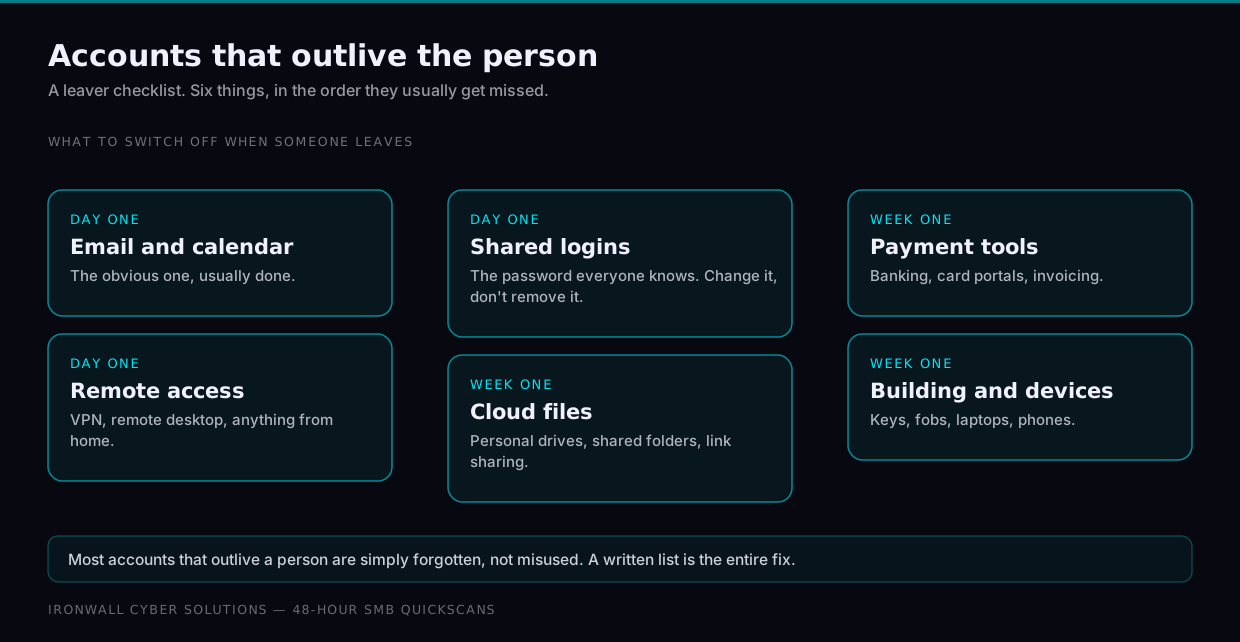
- Prompt offboarding. Revoke access the day someone leaves — email, shared drives, and every third-party tool they were ever added to. Lingering accounts from former staff are one of the most common gaps in small businesses.
- Logging and visibility. Keep a record of who accessed what. You cannot investigate, or learn from, something that was never written down anywhere.
- Multi-factor authentication everywhere. It directly addresses the compromised-account case by making a stolen password insufficient on its own.
- Separate duties for high-impact actions. Require a second person to approve payments, payroll changes, and bulk data exports.
When should you review who has access to what?
At four moments. Three of them are events you already know about, so the review costs almost nothing if you attach it to something that is happening anyway.
| Moment | What to review | Why it matters |
|---|---|---|
| New hire or role change | Grant what the new role needs; remove what the old one needed | Access accumulates as people move around and is rarely taken back |
| Anyone's last day | Email, drives, outside tools, and any shared login they knew | A very common gap, and one of the easiest of all to close |
| Long leave or a paused contract | Suspend the account rather than leaving it open and unattended | An idle account is still a fully working account |
| Twice a year, everything | Every person, every tool, every administrator login | Catches the drift that no single event would have surfaced |
How do you make it safe to report a mistake?
By deciding, out loud and in advance, that reporting one is the expected behaviour rather than a confession. This is the highest-value cultural change available to a small business, and it costs nothing to make.
The reasoning is simple. If people believe an error will be punished, they will hide it, and a hidden mistake stays open far longer than one that surfaces in ten minutes. A misdirected file can be recalled and a wrongly shared folder can be closed — but only if someone says something quickly. Silence is what turns a small problem into a large one.
Say plainly that anyone who reports a mistake or a suspicious message will be thanked, not blamed. Give people one obvious place to raise it. Then respond calmly the first time it happens, because that first response is what everyone else will remember when it is their turn.
The bottom line
Insider risk is not about suspecting your staff — it is about sensible limits. Least privilege, clean offboarding, visibility, and multi-factor authentication mean that whether an account is careless, compromised, or misused, it simply cannot reach far enough to cause a catastrophe.